


Resources / Blog
CAS Letter for the UK: What It Is and How It Works

16 min read

Last update: September 17, 2026


The CAS letter is the “Confirmation of Acceptance for Studies,” which you receive once your admission to the university has been confirmed. This confirmation letter is necessary for your student visa application to the UK, so it’s important to know what a CAS letter for the UK includes and how it helps in the visa application process.
Whether you are in the process of applying to universities or you have already been accepted to a university in the UK, this blog can help you understand what the CAS letter is, why it’s important, and how to get a CAS letter for the UK. Let’s get started.
What Is a CAS Letter?
A CAS letter is an electronic document, usually a PDF, issued to you by the university you’ve been accepted to. The CAS full form is Confirmation of Acceptance for Studies, and the letter contains personal information required for your visa, university and programme details, and a unique CAS number assigned to you for visa processing purposes.
To get a CAS letter, you’ll need to fulfil the requirements for the CAS letter and apply for it, submitting all the necessary information. Let’s have an in-depth look at the information included in the CAS letter.
What’s in Your CAS Letter for the UK
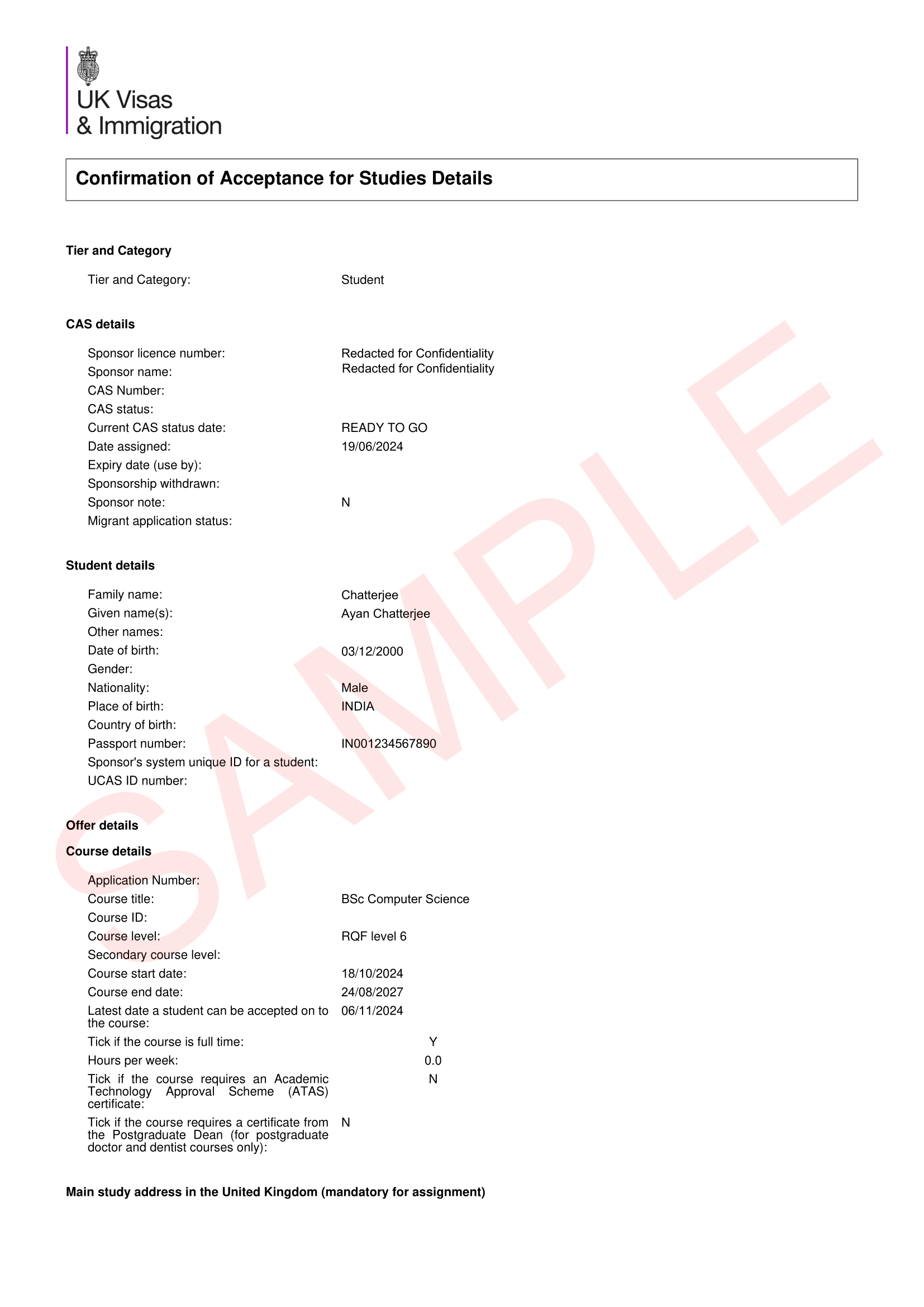
The CAS letter contains information that the UK Visas and Immigration (UKVI) office needs regarding your admission to the university. Your personal information, details of your university and the registered programme, confirmation that you’ve met entry requirements set by the university, and more are included, so let’s have a closer look:
- CAS number: A unique 14-digit number, also known as the CAS reference number, to confirm that you are an international student enrolled at a UK university
- The start and end date of your course: The beginning, duration, and end date of the programme you are enrolled in
- Sponsor Licence Number: The registered number of your sponsor, the university that is sponsoring your entry to the UK
- Sponsor Licence Address (registered address): The address of your university
- The address of your primary site of study: The address of the location where you will be studying, which can be different from the registered university address, especially as UK universities have many colleges in different locations
- Your qualifications: The academic qualifications the university has used to assess your eligibility for the programme you are enrolled in
- Confirmation of academic progress: Confirmation that the programme you are currently enrolled in indicates academic progress, if you have already studied in the UK
- Confirmation of your language proficiency: Your English language proficiency test scores to show your capacity in the language
- The fees for your course: Your total tuition fee or first-year tuition fee
- The fees you have already paid: The portion of the tuition or accommodation fees you’ve already paid to the university, if applicable
- Your name: Your name as it appears on your passport
- Your passport number: Your valid passport number
- Your scholarship information: Details of your scholarship, if you’ve been offered one
The details included in your CAS letter are digitally stored and can be accessed through your unique CAS number. When the UKVI processes your visa application, they will cross-check your personal information and supporting documents using the CAS number.
What Does a Sample CAS Reference Number Look Like?
Your CAS number is a unique 14-digit reference, for example E1234567890123. This is also referred to as your Confirmation of Acceptance for Studies reference number, and unlike a passport number, it does not break down into meaningful segments; it is simply a unique identifier that links your record on the UKVI’s secure database.
What matters is where it sits on your CAS letter and how you use it, rather than trying to decode the digits themselves.
| Where to Find It | What to Check |
|---|---|
| Top of your CAS statement or email | It matches exactly what you enter on your visa application form |
| Sponsor Licence Number field | Not to be confused with your 14-digit CAS number, this is a separate reference for your university |
| Passport number field on the CAS | Matches your current, valid passport, not an old or expired one |
What Is the Combined CAS Number?
The combined CAS number is issued to you if you are enrolled on two or more programmes at the same university. This usually happens if you register for a pre-sessional language programme that takes place before the start of your academic programme.
In such circumstances, the university will give you a CAS reference number that includes all information relevant to both of your registered programmes. Your visa is granted for the entire combined period, and the financial evidence you must show is calculated on the total combined duration rather than just the main degree.
CAS Letter Sample for the UK
With the core information covered, here is a sample of what a CAS letter issued to you looks like:
 |
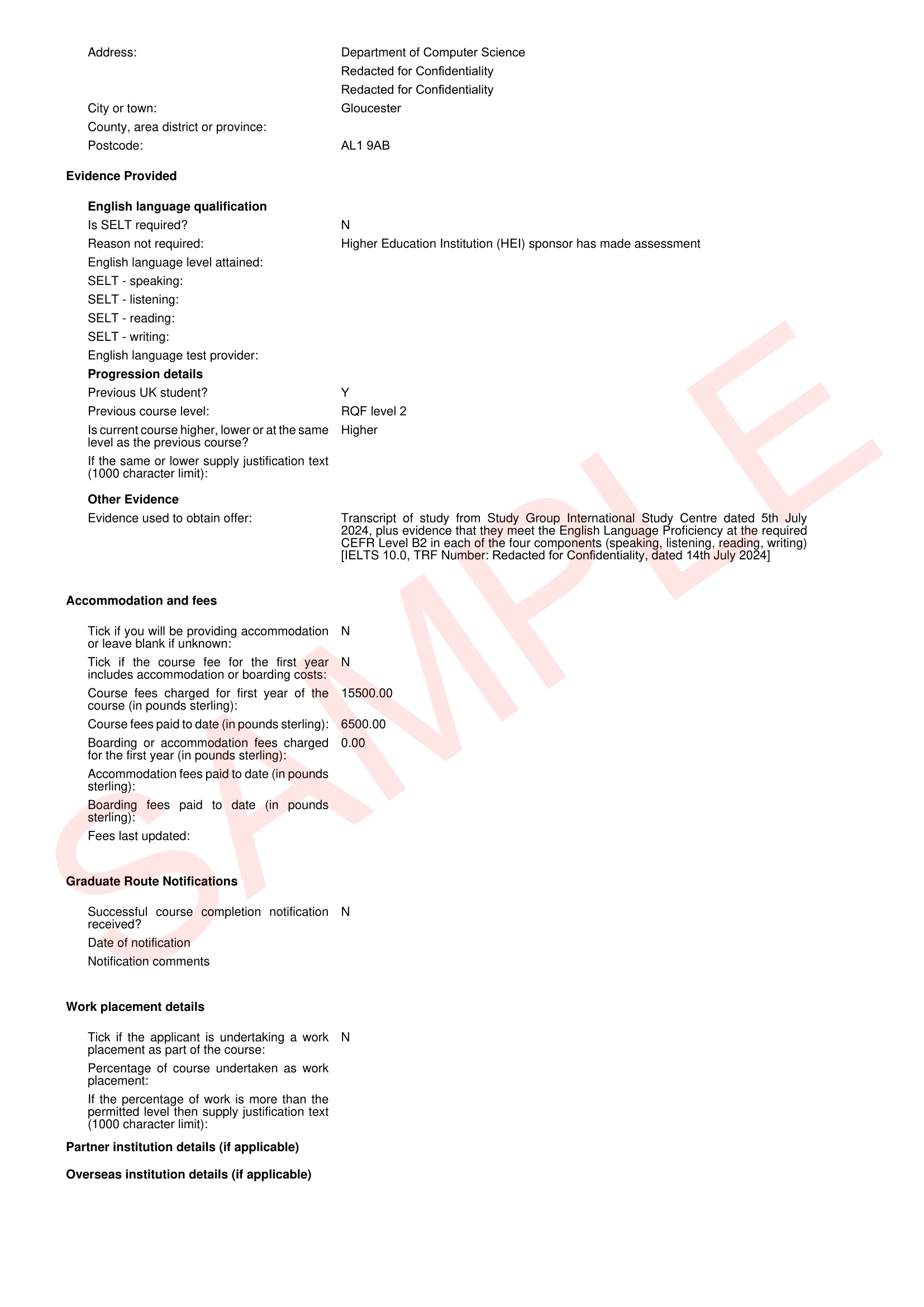 |
This sample covers all the components of a CAS letter, but as the CAS letter is issued by the university, there can be slight differences in the format.
As long as your CAS letter includes all the information you need to submit alongside your visa application, there is nothing for you to worry about. Now, let’s find out why the CAS letter is required when you apply for a visa to enter the UK as an international student.
Why the CAS Letter Is Important for the UK
The CAS letter is the official confirmation from your university that you have been accepted into a programme at the institution. The UK Visas and Immigration office requires this information to cross-check with the details in your visa application, confirming you are a genuine applicant who has been accepted to a licensed educational institution in the UK.
Your visa may be rejected if your CAS information is not in line with the details you provide in your visa application. You must provide correct information and avoid any errors or inconsistencies when including your details for the CAS letter and your visa application.
If you want to learn more about the visa application process and the documents you need, our guide on the visa document checklist can help.
What You Also Need Alongside Your CAS in 2027
A CAS letter confirms your place, but it is only one part of a Student visa application. For most 2027 intake applications, submitted on or after 30 November 2026, you will also need to show the following:
| Requirement | Figure From 30 Nov 2026 |
|---|---|
| Maintenance funds, London (9 months) | £14,130 |
| Maintenance funds, outside London (9 months) | £10,827 |
| Continuous fund holding period | 28 days, ending no more than 31 days before you apply |
| Student visa application fee | £558 |
| Immigration Health Surcharge | £776 per year |
Any outstanding tuition or accommodation fees shown on your CAS also count towards the total you need to demonstrate, so it is worth checking this figure carefully once your CAS is issued. If you’re applying before 30 November 2026, the maintenance funds thresholds are currently £13,761 (London) and £10,539 (outside London) instead, under a Statement of Changes published by the Home Office in September 2026, so confirm which figure applies on the date you actually submit your application.
Note that these maintenance fund amounts are set to rise to £14,130 (London) and £10,827 (outside London) for applications submitted on or after 30 November 2026, under a Statement of Changes published by the Home Office in September 2026, so confirm the current figure at the time you apply.
Expert View
“Check your maintenance funds have sat untouched for the full 28 days before you apply. Even a brief dip below the threshold can invalidate your financial evidence, and UKVI makes no exceptions.” – Rahul Chauhan, Counsellor, StudyIn.
If you are looking to apply for your CAS letter, the next section covers all you need to know about the process.
How to Get a CAS Letter for the UK: The CAS Application Process
Getting a CAS letter for the UK can be a lengthy process, but it is not too challenging if you fulfil the requirements and follow the right process. Here is the process, step by step.
Step 1
Accept your unconditional offer
Step 2
Pay your fees if required
Step 3
Log on and submit your information
Step 4
Receive your CAS letter
Step 1: Accept an Unconditional Offer
If you are selected for the programme you applied for, the university will send you an offer letter. If it is an unconditional offer, meaning that you have been offered a place at the university without any conditions, you can proceed to the next step by accepting the offer.
What to Do if You Have a Conditional Offer
A conditional offer means that the university is offering you a place on your programme on the condition that you will fulfil one or more unmet entry requirements.
For international students, the condition would often be that they meet the language proficiency requirement, which you can do by achieving the accepted score in the language test preferred by the university. Once you meet the conditions, you can follow the same process for the CAS letter as you would with an unconditional offer.
Step 2: Pay Your Fees if Required
Some universities may need you to deposit your tuition fee or your accommodation at the point of admission. You need to complete this payment to secure your place, and once the transaction is complete, you will have successfully enrolled on the programme you applied to.
Step 3: Log Onto the Online Portal and Input Information
Along with correspondence from your university, you will receive an invitation link to an online portal, and depending on your university, you may access the CAS Shield or the OSIS platform.
What Is CAS Shield?
CAS Shield is an online self-service system that facilitates the issuance of your CAS letter. When you log in, it will already have the information you provided in your application added to the system as your CAS statement, and you will be required to verify it. The CAS Shield can also be used to track the progress of your CAS letter once you have submitted the required documents.
What Is the OSIS Platform?
The Online Student Information System (OSIS) is an online portal provided by some UK institutions. You can access your OSIS account using the login credentials provided by the university. For example, if you’re applying to University of East London (UEL) or any other UK institution, your CAS letter will follow this same general structure, though the exact online portal used to issue it may differ by university.
What Are the Required Documents for the CAS Letter?
When you are asked to confirm the information in the online portal, you will also need to submit a few documents for the verification process:
- Transcripts and mark sheets: Documents to confirm your academic qualifications and grades
- Passport: Valid and up-to-date passport, along with a soft copy that you would need to submit
- Proof of financial capacity: Financial documents to show that you can pay your tuition and afford life in the UK
- Language proficiency test scores: Proof of your English language capacity
- TB certificate: Confirmation that you have not contracted tuberculosis
- ATAS certificate: Security clearance if the knowledge gained from your programme may have application in the development or delivery of weapons of mass destruction, if applicable
If you run into any inconsistencies during verification, you need to alert your university immediately, along with the necessary details to update the information.
Step 4: Issuance of Your CAS Letter
When you have verified the information and the supporting documents you have submitted are approved, the university will issue your CAS. The review process and issuance of CAS letters are done on a first-come, first-served basis, so there is no fixed time it may take.
What Is the CAS Letter Processing Time?
Usually, universities take around 10 days to issue your CAS letter after confirming the details in the CAS statement. You should reach out to your university’s admission office if it is taking longer than expected.
What Is the Deadline to Apply for CAS as an Indian Student?
Some universities give you a deadline you will need to meet to apply for the CAS, and if you have not been given one, you can apply as soon as you get your unconditional offer and your supporting documents are in order.
CAS applications from international students are usually accepted within 90 days before the start date of your course. Since June 2026, UKVI has also introduced a new Red, Amber, Green compliance rating for universities, which directly affects how many CAS letters a sponsor can issue.
Universities with a lower rating may have their CAS numbers restricted or frozen, which can mean earlier internal deadlines and fewer places available even for qualified applicants. Applying as early as possible is now more important than ever, so check and confirm the CAS deadline with your university’s admission office to avoid delays.
There is a lot of documentation involved in the CAS application process, and it is understandable if you feel overwhelmed when starting. If you do need support, help is always at hand, and you can reach out to your university’s admission office via email or a contact number if you have been provided one. Once you receive your CAS letter, the next part of your journey to the UK as an international student begins, so let’s learn more about what happens next.
What Happens After You Get the CAS Letter?
Your university will send you your CAS letter along with the unique CAS reference number via email. You can then apply for your student visa at the UKVI within six months of receiving the CAS letter.
Keep in mind that you cannot begin your visa process until you get your CAS letter, and there are other supporting documents you need to put together for your visa application. If you need support with your visa application, our visa experts can help via our Visa Support Service.
What Should You Do if You Have Multiple CAS Letters?
There may be rare cases of a student acquiring more than one CAS letter, and in that case, you would need to choose your preferred university, as multiple CAS letters are not accepted by the UKVI. Here is what you can do if you have multiple CAS letters:
- Review the courses offered by each university, considering curriculum, specialisations, research opportunities, and career prospects
- Check university rankings and the reputation of universities
- Look at location and campus life, considering the city’s livability, accommodation, student support services, and extracurricular activities
- Check tuition fees, cost of living, and available scholarships at each university and determine which option works best for you
- Get advice from a mentor, a past student, or a current student
- Visit university open days or virtual events to understand the university culture, facilities, and learning environment
- Reflect on your personal and career goals to see if the university and chosen programme can help you achieve them
- Make a well-informed decision
If you need guidance to weigh your options once you receive your CAS letters, you can always schedule a free counselling session with one of our experts to make your choice.
When you are applying for your CAS letter, following the steps provided by your university and being thorough and consistent with your supporting documents can go a long way. This way, you can obtain your CAS statement without delays and get started on your visa application, the next big step in your academic journey in the UK. Good luck!
FAQs
Is it challenging to get a CAS letter in the UK?
Obtaining a CAS letter in the UK can be a lengthy process, but it is generally not too challenging. You will need to meet the university’s admission requirements, provide accurate and complete documentation, show sufficient financial capacity, and satisfy the UKVI’s requirements, but if your application is in order and you can show supporting documents, you should not find the process too difficult.
How long does it take for the CAS letter to be issued?
This depends on your university, but the usual processing time is around 10 days. There can be delays if the admission team is exceptionally busy during general intakes or if the documents you have provided have inconsistencies. It is best to apply for your CAS letter well in advance to avoid potential delays.
What should I do if my CAS letter has expired?
You can request a new CAS letter from your university if yours has expired. The CAS letter is usually valid for six months, and if you do not apply for your visa within that time, you will need another one.
Why does a CAS letter get rejected?
A CAS application can get rejected if you provide incomplete or inaccurate information and do not meet the university’s admission requirements or UKVI’s criteria.
Does a CAS letter guarantee a visa?
No. Obtaining a CAS is a crucial step in the student visa application process, but it does not guarantee the issuance of a visa. The CAS is evidence of your acceptance into the university and provides important information for your visa application. The final decision on granting a student visa sits with the UKVI, who will assess your application based on factors such as financial capacity, English language proficiency, genuine intention to study, and meeting the immigration requirements.
Do I need IELTS if I have a CAS letter?
Yes. Having a CAS letter does not exempt you from meeting the English language proficiency requirements for a UK student visa. In most cases, you will still need to show your English language skills by providing a valid test result, such as IELTS, TOEFL, or PTE Academic.
Is a CAS interview compulsory?
No, a CAS interview is not a standard requirement for obtaining a CAS or a UK student visa. In some cases, though, the university or UKVI may request an interview to verify the authenticity of the information provided in your application. The interview may be conducted in person, over the phone, or via video call, and you will be notified if one is required.
Can a UK student visa be rejected with a CAS letter?
While it is rare, a UK student visa application can be rejected even after obtaining a CAS. The UKVI has the final authority to approve or reject a visa application, and they consider factors such as meeting the immigration rules, providing genuine documents, financial capacity, and English language proficiency.