






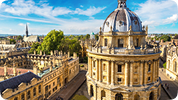



Oxbridge Entry Requirements
Required grades and application information for international students.
Oxbridge Entry Requirements
Oxford and Cambridge Entry Requirements
Tough entry requirements, famously difficult interview questions and standardized tests are all required to successfully apply to Oxbridge universities. Before applying, students must answer two basic questions about their future:

What do you want to study?
Where do you want to study it?
It is not possible to apply to both Oxford and Cambridge in the same admissions round, so choose one or the other. Some courses are offered at one of the universities, but not the other. The deadline for Oxbridge applications is October 15th.
Studyin is able to provide assistance with applications to Oxbridge universities, speak to your Consultant about our Oxbridge Service.
Undergraduate Oxbridge entry requirements
While many UK universities may offer students a conditional offer based on specific skills, extra-curricular talent or previous experience, at Oxford and Cambridge it is your academic ability that is the sole interest of tutors and admissions officers. Entry requirements are subject to change, please speak to an StudyIn Consultant for the latest information on Oxbridge entry requirements.
University of Oxford
International Baccalaureate – IB Students are usually required to achieve a level of performance of 38–40 points, including core points, with 6s and 7s in the higher-level subjects.
Ontario
Secondary School Diploma with six Grade 12 courses, to include no more than two 4M courses, each passed at 85%. Students are encouraged to choose U-course options in the subjects relevant to the degree of study.
British Columbia
Senior Secondary Graduation Diploma with five Grade 12 courses, each passed at 85%.
Alberta
General High School Diploma with five Grade 12 (Level 30) courses, with a final average of 85%.
Quebec
The Collège d’Enseignement Général et Professionnel Diplome d’Etudes Collegiales (CEGEP DEC) with a final average of 85%.
Manitoba
High School Graduation Diploma with five Grade 12 (Level 300) courses within four subject areas, each passed at 85%.
Saskatchewan
Completion of Grade 12 Standing / Division IV Standing with five acceptable Grade 12 courses, each passed at 85%.
New Brunswick
High School Graduation Diploma with five grade 12 courses, each passed at 85%.
Newfoundland and Labrador
High School Graduation Diploma with five grade 12 courses, each passed at 85%.
Nova Scotia
High School Completion Certificate with five Level 4 and 5 Courses, each passed at 85%.
Nunavut
Grade 12 Diploma, with five Grade 12 courses, with a final average of 85%.
Prince Edward Island (PEI)
High School Graduation Diploma with five acceptable Grade 12 courses, each passed at 85%.
Northwest Territories
General High School Diploma with five Grade 12 courses, each passed at 85%.
Yukon
Senior Secondary Graduation Diploma with five Grade 12 courses, each passed at grade A.
University of Cambridge
For students to be considered for admission to Cambridge, the Canadian High School Diploma/Secondary School Diploma is not sufficient on its own. This applies to applicants from all provinces and territories, including Québec CEGEP students.
Applicants from Canada who are taking the high school diploma must therefore be studying for further qualifications in addition to the high school diploma. These can be either:
Five College Board Advanced Placement (AP) Tests in appropriate subjects (for details of
required and preferred subjects for your proposed degree course, please see the relevant course descriptions page, noting that we treat APs as equivalent to A Levels).
Please note that SAT Subject Tests are not normally viewed as being equivalent to Advanced Placement (AP) Tests.
or
Three International Baccalaureate Higher Level subjects in appropriate subjects (for details of required and preferred subjects for your proposed degree course, please see the relevant course descriptions page, noting that we treat IB Higher Levels as equivalent to A Levels).
In addition, applicants would be expected to achieve a minimum of 90% overall in the relevant provincial High School/Secondary School Diploma.
Please note that the assessment from the University of Cambridge of the high school final % is based on grade 12 English and the best 5 other grade 12 scores.
Alternatively, students can apply if they are studying the full International Baccalaureate (IB) Diploma (out of 45 points, including three appropriate Higher Level subjects). In this case, applicants do not need to offer a high school diploma as well.
For students studying the International Baccalaureate, offers usually require scores between 40 and 41 points out of 45, with 776 in Higher Level subjects. Depending on individual circumstances, applicants may be required to achieve 7 in a particular subject.
Postgraduate entry requirements
University of Oxford
If the Oxford program listed requires a ‘strong upper second-class undergraduate degree with honours’ in the UK system, you will usually need:
A bachelor’s (honours) degree or a general four-year bachelor’s degree with an overall grade of ‘B+’ or 76%, or a GPA of 3.1 out of 4.0;
Bachelor’s degree (Baccalauréat/Bachelier, without honours) from Quebec with an overall of ‘B+’ or 76%, or a GPA of 3.1 out of 4.0; or
An applied bachelor’s degree with an overall grade of ‘B+’ or 76%, or a GPA of 3.1 out of 4.0.
If the Oxford program listed requires a ‘first-class undergraduate degree with honours’ in the UK system, you will usually need one of the above qualifications with an overall grade of ‘A’ or 83%, or a GPA of 3.6 out of 4.0.
University of Cambridge
If the Cambridge program listed requires a ‘strong upper second-class undergraduate degree with honours’ in the UK system, you will usually need:
Bachelor’s degree (Honours) or 4 years Bachelor’s without Honours with an overall grade of 3.3/4, 3.3/4.3
B+, 77% or Baccalauréat / Bachelier (first-cycle degrees in Quebec province (3 years) (except McGill University)
Overall grade of 7/9 (York University) or Bachelor’s degree (Honours)
Bachelor’s without Honours (3-4 years with 120 credits) from McGill University
First Professional Degree / Grade Professionnelle (titles include Doctor of Dental Medicine / Surgery, Doctor of Medicine and Juris Doctor)
If the Cambridge program listed requires a ‘first-class undergraduate degree with honours’ in the UK system, you will usually need:
Bachelor’s degree (Honours) or 4 years Bachelor’s without Honours with an overall grade of 3.7/4, 3.7/4.3
A-, 82% or Baccalauréat / Bachelier (first-cycle degrees in Quebec province (3 years) (except McGill University)
Overall grade of 8/9 (York University) or Bachelor’s degree (Honours)
Bachelor’s without Honours (3-4 years with 120 credits) from McGill University
First Professional Degree / Grade Professionnelle (titles include Doctor of Dental Medicine / Surgery, Doctor of Medicine and Juris Doctor)
Oxbridge Personal Statement
A great emphasis is placed on your personal statement at all UK universities, and Oxbridge is no different. Ensure you highlight your academic pedigree and what experience you have – both practical and theoretical – in the subject you are applying to. This personal statement will be used as a guide by admissions tutors during your interview, so ensure there is no stone left unturned and you can speak confidently about what is submitted.
Oxbridge Tutorial System
The tutorial system is a particular advantage of Oxbridge but is by no means suited to all potential students. Students at Oxford and Cambridge benefit from highly personalized teaching time with experts in their field. Oxford refers to these sessions as “tutorials” while Cambridge calls them “supervisions”. Oxford and Cambridge courses tend to be traditionally academic with formal assessments often entirely based on examinations.
Your Oxbridge Consultation
Are you interested in learning more about undergraduate and postgraduate Oxbridge courses? Arrange your free consultation today. For more assistance with your application to an Oxbridge university, ask us about our Oxbridge Service.
Menu
Events
Pre-Departure Briefing


Funding Your UK University Studies
UCAT Training - Final Session
Visa: Everything You Need to Know

Visit our blog
Explore more services
Oxbridge Undergraduate Service
Application help for international students applying to Oxbridge undergraduate courses.
Oxbridge Postgraduate Service
Application help for international students applying to Oxbridge postgraduate courses.
Oxbridge Entry Requirements
Required grades and application information for international students.